Autographs on railroad certificates
My stance
I DO NOT consider myself an expert on autographs. Autograph validation is an endeavor with financial ramifications. I want no part of valuing autographs.
I DO NOT authenticate autographs. I recommend that you address all questions involving purchase or sale of potentially valuable autographs to third-party experts.
I DO NOT list all autographs that might be found on railroad or coal certificates. (see Autograph Listing Criteria.)
Background
Autograph collecting is a separate hobby that happens to intersects the stock and bond hobby. Railroading was THE big industry before 1900, so many celebrities were investors. Many celebrity autographs ended up on railroad stocks and bonds, Yes, autographs can be important for their historical significance and their speculative possibilities. However, just because a person was a "celebrity" in one part of the country or in one industry does not mean their autographs have hobby-wide value.
Do your research
Newcomers often believe autographs represent excellent opportunities for "investment." A warning is in order.
No one can stumble into the autograph hobby and reasonably expect to win right away. Autograph collecting takes careful research and time. It requires a clear understanding of the market. Speculation in autographs can be disappointing when it comes time to sell.
High-class autographs
Autographs that show the greatest demand among advanced collectors of railroad certificates are those of
- major industrialists (e.g. John D. Rockefeller, Andrew Carnegie, etc.)
- major investors (e.g. Hetty Green)
- legendary railroaders (e.g. Commodore Vanderbilt)
- major historical figures (e.g. Nathan Bedford Forrest)
- famous scoundrels (e.g. James Fisk)
Signatures of that caliber routinely attract prices in the thousands of dollars. At that level of collecting, all speculative value is in the autographs. The values of certificates on which they appear are normally ignored.
Important signatures often show price increases over time. Even if true, "beating inflation by a few percent per year" does not necessarily guarantee a reliable investment.
Autographs of medium importance
Down the ladder of importance are signatures of:
- prominent railroaders (Jay Gould, E. H. Harriman, Collis Huntington, Thomas Scott, etc.)
- second generation Vanderbilts
- important industrialists (J. P. Morgan (below), duPont, Mellon etc.)
- politicians (Fillmore etc.)
- prominent Civil War military figures (Burnside, etc.)
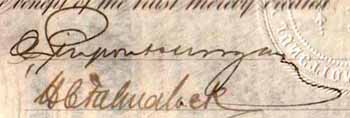
People in this group were important Americans, but collectors pay less for their signatures on certificates. Their popularity is flexible. They are in a different class than the previous group, but like the previous group, their signatures are worth more than the certificates they grace. Condition and rarity of underlying certificates can affect prices.
Autographs of lesser importance
In less demand are signatures of minor figures. This group includes autographs from people like Alexander Cassatt, Henry Clews, Chauncey Depew, Galusha Grow, and William Mahone. These people were important to their companies. Many were well known, even famous, in their time. However, they had limited impact on the nation as a whole. This group includes most Civil War generals.
At this level of collecting, prices often reflect a combination of autographs and certificates. Expect to pay $5 to $100 for autographs from this group plus the price of certificates on which they appear. Buy autographs from this group more for their desirability than for speculation. Always consider potential resale. Just because someone can be convinced to buy such autographs today does not guarantee similar interest in the future. When considering these kinds of autographs, try to buy autographs on scarcer certificates and make sure handwriting is legible and minimal cancellation.
Locally-important autographs
Autographs from locally important figures are the most unpredictable group. These are people who were important in one city, one county, or one state, but who had little importance elsewhere. Such autographs can attract high bids in one auction and go unsold in the next. These kinds of autographs are the realm of specialists.
Use caution
Be cautious when first collecting autographs. Collectors will frequently encounter autographed certificates for sale with unfamiliar names. That indicates collectors need to do more research before purchase. Collectors should never buy so-called "autographs" until they know whose signatures they are buying and why they need to own them.
The role of sellers
The goal of sellers is to make every certificate sound appealing. When it comes to autographs, sellers need to make every signatory sound important. Never mind whether autographs may be dreadfully common. Never mind that signatories might not have been remotely important. I beg collectors not to fall for huckster hype. Not all autographs are valuable.
This website is about collecting railroad stocks and bonds, not autographs. Consequently, for the reasons mentioned above, I do NOT list every possible autograph that dealers may have promoted.
Let me stress this point for clarity.
Appearances of autographs in a handful of catalogs, dealer lists and especially eBay sales are NOT sufficient reasons for inclusion. Please see my extended discussion of listing criteria.
What exactly is an autograph?
For the purposes of this catalog, an autograph is:
- A hand-signed signature, usually in ink, by the person whose name appears.
An autograph is NOT:
- A printed or rubber stamped facsimile signature.
- A signature signed by a mechanical device (Autopen or Signa-Signer).
- A signature signed by a "surrogate" or "secretarial" signer. (i.e., anyone other than the person named.)
Here are two examples of Henry Flagler's signature. The one on the left is an authenticated signature that appears on many stock certificates of the Standard Oil Company. (Image courtesy of Bob Kerstein at Scripophily.com). The signature on the right appears on many "special stock" certificates of the Valley Railway Company. It is a "secretarial" signature, probably signed by George Mason in 1886, agent for the trustees of the company.
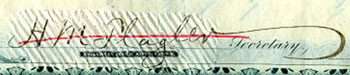 Legitimate signature
|
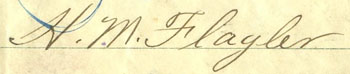 Secretarial signature
|
Issued to, but not signed by...
In this price guide, you will see sporadic references to certificates that were issued to famous people, although the celebrities never signed them. Such certificates are not autographed. Nonetheless, they carry famous names, so they sometimes attract auction bids above ordinary certificates.

Signed for companies
Many investors became so successful or notorious that they became celebrities in their own rights. Famous investors include people like Henry Clews, Daniel Drew, Russell Sage, J.P. Morgan, Jay Cooke, Hetty Green, and others. Many of those investors formed their own brokerages and held investments for others in their company accounts. During the normal course of buying and selling securities, brokerages hand-signed tens of thousands of certificates. Some of those endorsements represent the signatures of famous investors, but many are simply the handwriting of clerks. Be very cautious if certificates are issued to brokerages and sellers say they were signed by famous individuals. I have seen MANY examples of this behavior on eBay. Do not enticed by amateur sellers. Confirm authenticity for yourself. (Beow are examples of authentic and secretarial signatures of Henry Clews. The image on the right signed as "Henry Clews & Co." The signature is NOT from Henry Clews himself.)
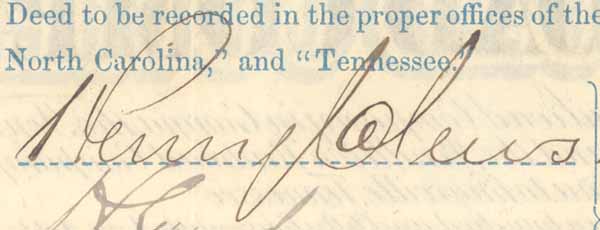 Legitimate signature
|
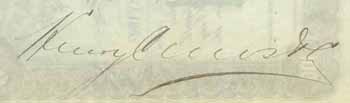 Secretarial signature for company
(deceptively sold on eBay as real)
|
Pens used for autographs
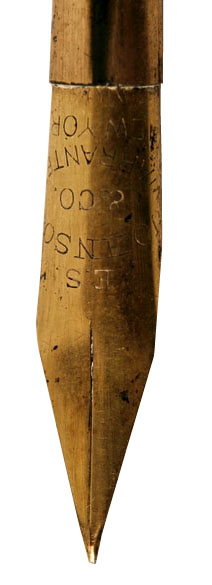
Prior to the 1950s, almost all stocks and bonds were signed by steel nib pens. Very early securities were probably signed with quill pens, and well-tended quills made some very fine lines. (See how quill pens were made at Medievaljourney.com.) Steel nib pens were probably widely available by the 1840s. (See a bit of history at ZenZoi.com.) At the time of signing, ink was usually black or bluish black. Over time, many of those inks aged to a brown color. Many old autographs on certificates show a brown halo caused by migration of the liquid agent (usually linseed oil) that held black pigment.
Signatures signed in ball point pen started appearing in the 1950s. You will occasionally find certificates signed by ball point pens that should have been signed with fountain pens. These were commonly signed by children long after dates of genuine issuance. While no purposeful malice or deception may have been intended, such certificates represent fantasy signatures. Try to avoid buying such items because they may be unsalable later.
The earliest ball point pen patent was issued in 1888, but the modern ball-point pen was not perfected until about 1935. Even then, those early pens experienced serious problems with ink flow. In practice, ball point pens were not sold in large quantities until the Christmas season of 1945. Certificates signed before late 1945 should be examined carefully and those signed before 1935 have a high probability of being forgeries or fantasies.
Facsimile autographs
Facsimile signatures were usually printed by offset or intaglio presses. Some were applied by rubber stamps. While a few facsimile signatures have proven problematic, there are four good methods to differentiate facsimile signatures from genuine autographs.
- One good way is to flip certificates over. If ink soaked through the paper or was wicked along paper fibers, you have a real signature. Printed facsimile ink sits on top of the paper and never soaked through.
- Real autographs sometimes dented paper and the evidence can be seen most easily from the backs of certificates.
- Look closely where pen strokes cross each other. If the junction of two strokes is the same shade of black as the surrounding pen strokes, you are probably dealing with a facsimile. (Experiment with both fountain pens and ball-point pens to see how ink coverage becomes heavier where pen strokes cross.)
- Facsimile signatures were usually created by a plate that printed black text elsewhere on certifictes. Black text and facsimile signatures will be the same shade of black.
Facsimile signatures are common on recent stocks and bonds, but it is hard to pinpoint exactly when they first appeared. The New York Central used pre-printed officers’ signatures in the 1940s and thereafter. The earliest recorded facsimile signature in this database is currently attributed to a New York Central specimen (NEW-530-Ss-65) from 1914. Facsimile autographs are fairly common on railroad passes dated as early as the mid-1880s. A facsimile signature is shown below. Notice that the whole signature, even where the crossbar on the 'T' trails off, is the same shade of black.
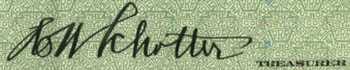
There is no easy way to discriminate between Autopen signatures and genuine handwritten signatures. Generally, you need several certificates for comparison. If several signatures are identical in flow and appearance, you have a mechanically-made signature. If the signatures vary from example to example, you probably have genuine signatures. (Notable exceptions are signatures of 20th century U.S. Presidents where several different auto-signing machines were/are used concurrently.)
Authenticity
Authenticity is a serious issue in autograph collecting. Fortunately, the engraving on stocks and bonds is usually so complex, and certificates are still so cheap, that counterfeiting whole documents makes little sense. However, there is nothing to prevent forgers from buying unissued certificates and adding fake signatures. Theoretically, they can also remove worthless signatures from issued certificates and substitute forgeries of valuable autographs.
As of mid-2022, stock and bond autograph forgeries had proven very rare. I fully expect that to change at some point. Protect yourself as much as possible. Buy autographs from reputable, established dealers who unequivocally guarantee their sales. For valuable signatures, seek expert authentication from one or more third party appraisers completely separate from sellers. Contact one or more of the dealers I have listed on the dealer's page.
Finally, read these books:
- Questioned Documents, second edition: The discovery and proof of the facts, 1929, Albert S. Osborn (available in reprint form)
- Collecting Autographs and Manuscripts, 1961, Charles Hamilton (see Amazon and secondhand book sellers)
For those who think they have a special sixth sense that allows them to detect a forged autograph on a certificate, PLEASE read:
- Salamander: The story of the Mormon forgery murders, 1988, Linda Sillitoe and Allen Roberts (see Amazon and elsewhere)
Prices for autographed certificates
As mentioned near the top of this page, autographs of famous people can add significantly to the prices paid for otherwise common stocks and bonds. Autographs remain popular as so-called "investments." H-O-W-E-V-E-R, Collectors must make sure they fully understand the difference between investment and speculation. If they are looking at this part of the collecting hobby from a profit perspective, they need to quantify the ease and costs associated with buying and selling their "investments." Top-tier autographs are normally bought and sold through professional auction houses. Those businesses charge commissions to both buyers and sellers and those charges can seriously limit profits on "investments."
Fame and autograph demand
In very general terms, the richer and more influential the individual was during his or her lifetime, the greater the collector demand.
Autographs from last century’s millionaires are usually in high demand. Collectors pay much less for autographs from heirs and offspring. Signatures from celebrity spouses and more remote family members are usually collected by specialists.
Unless company officials were notorious, rich, or both, autographs of company presidents seldom attract attention outside of specific collecting specialties (mining, railroading, petroleum, automobiles, etc.) Autographs from persons of pure celebrity (movie stars, composers, sports figures) are priced roughly in comparison with their enduring fame. The prices paid for autographs from politicians, military figures, judges, crooks, and other notables roughly track the degree of their national impact.
Presently, the highest-price paid for an autograph on a railroad certificate was that of Andrew Carnegie. It appeared on a Pullman Palace Car stock certificate and sold for over $70,000 in a January, 2000 R.M. Smythe sale (sale 194, lot 2150). Other extremely valuable autographs include Commodore' Cornelius Vanderbilt, founder of the New York Central Railroad and the Vanderbilt dynasty. Regardless of his commanding presence in railroading, his signature is extremely rare on railroad certificates. Other notables include Hetty Green, James Fisk, Henry Frick, and John D. Rockefeller. Signatures from Jay Gould are moderately valuable on items other than MKT stocks.
Problematic pricing
Prices paid for autographs depend on one thing – how important buyers think autographs should be. One buyer may be enamored with the tenacity of John Casement (below) as he drove the Union Pacific westward across the continent. Another might wonder, "Who?"
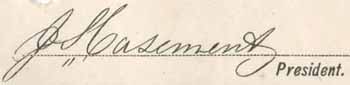
In other words, the perceived value of every autograph is personal.
Make no mistake, there are great rifts between theoretical "values" and "prices paid." Prices can be seen and recorded. "Values" cannot. Price estimates of autographs in this catalog originate from prices realized at auctions. In most cases, auction prices represent competition between two or more bidders. Prices in fixed-price catalogs and websites are usually higher.
Look before you leap
Buy autographs cautiously, especially when first starting. Study all aspects of autograph collecting before purchase. Prices are cyclic. Autograph prices CAN AND DO FALL! Financial returns are never guaranteed.
Think about resale
Sensible or not, autograph collecting is often equated with investing. Consequently, buyers should always keep an eye on potential resale.
If buying autographed certificates as speculation, never buy before assessing sales future potential. Will many people want a prospective signature in the future? It is fairly easy to predict sales of Commodore Vanderbilt's signature. J.P. Morgan's is more difficult. What about autographs from Henry Clews and Chauncey Depew?
Uncontrollable events affect prices
Random events affect people’s impressions about the importance of specific autographs. For example, consider 1869 bonds from the Selma Marion & Memphis Railroad. Most were signed by Confederate hero Nathan Bedford Forrest.
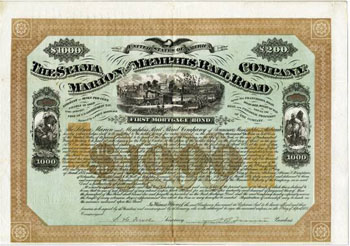
SM&M Railroad bonds with Forrest's signature usually sold for $150 to $250 in 1989. Then, in September, 1990, Public Broadcasting Services aired Ken Burn’s Civil War series. Within weeks, dealers in a wide range of hobbies noticed an unprecedented interest in practically every kind of collectible related to the Civil War. By 1992, Selma Memphis & Marion bonds were selling for as much as $900. By 1994, auction prices had topped $1,100. The high water mark seems to have occurred in June, 1999 when R.M. Smythe & Co. sold four SM&M bonds with Forrest's signature at the Memphis International Paper Money Show (Smythe sale 188, lots #1981, #1982, #1983 and #1984.) The first three bonds fetched $3,410, $2,310 and $1,430 respectively. Lot #1984 was a newly-discovered variety and sold for $7,150. Since then, SM&M bonds with Forrest's signature have remained popular. In the last ten years, sales prices have ranged from $898 to $3,500 with both high- and low-priced items sold on eBay.