Autograph listing criteria
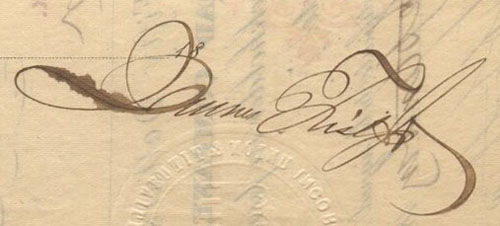
1871 signature of James Fisk Jr.
courtesy of Eric Jackson
Signatures from important celebrities can appear on certificates of all specialties. They have the capacity for increasing collector values, sometimes tremendously. Be aware that autograph collecting is a separate hobby that overlaps our hobby of collecting railroad stocks and bonds.
Autograph collecting has its own separate market and its own valuation criteria. It is easy to get overly-enthused with autographs that appear on certificates, so I must start with a few cautionary warnings.
I have seen collectors get sucked in by seller hype. I have seen collectors pay stupid prices for autographs from people of minor significance. I need to warn collectors that collector interest or collectible values in one location or one market may not be reflected elsewhere. Therefore, I do NOT list all signatures that have appeared for sale. I advise keeping perspective.
Let's look at a few estimates to get a feel for the magnitude of possible "autographs" that might be offered in popular categories:
| Category |
Role |
Estimated persons |
| Civil War |
in-service generals |
950 to 1,000 |
| Civil War |
brevet generals |
about 1,367 |
| Civil War |
posthumous generals |
less than 10 |
| Civil War |
in-service colonels |
7,000 to 10,000 |
| Politician |
territorial governor |
450 to 550 |
| Politician |
state governor |
2,400 to 2,500 |
| Politician |
U.S. Senator |
about 2,000 |
| Politician |
U.S. Representative |
about 11,000 |
| Politician |
State Senator |
60,000 to 75,000 |
| Politician |
State Representative |
180,000 to 220,000 |
| Politician |
Major city mayor |
14,000 to 18,000 |
| Officer |
President major railroad |
1,500 to 2,500 |
Civil War Generals. Many sellers promote autographs from Civil War generals. About a thousand legitimate generals saw service during the war. Even more were awarded brevet general status or posthumous ranks of general. Not all those men had laudable careers. Not all their signatures have persistently elevated valuation.
Senators, Representatives, and Parliamentarians. While it normally takes substantial effort to convince people to elect people to elevated political offices, only a small number of politicians were important celebrities.
Governors. Over 2,400 people have served as state, territorial, and provincial governors. (Download a full list from Inter-university Consortium for Political and Social Research.) Several hundred more served as colonial and acting governors. Consider that hundreds of thousands of people have served as federal judges, state judges, state senators, state representatives, and mayors of large cities. The number of people who have held political offices in the United States runs into the millions. Millions more held similar offices in Canada, Central America, and the Caribbean islands. Autographs from all those people are locally collectible, but only a tiny fraction are predictably valuable in a global hobby.
Business people and developers. It takes powerful grit and staying power to develop and profit from building railroads and opening coal mines. Most who succeeded were applauded in their lifetimes. The problem for collectors is to decide which of those thousands are genuinely memorable decades or centuries afterward. Not all qualify.
Semi-celebrities and obscure people. Yes, it is true that autographs from obscure people have value to specialist collectors. Practically every signature could have value to someone. It is perfectly fine to collect obscure autographs. Do not be deluded to think those same autographs will be valuable to other collectors. I am very serious in warning that some promotions of autographs by amateur sellers verge on outright deception.
Great fame within a narrow span of time or within a restricted region of the world does NOT automatically convey enduring celebrity elsewhere — or forever.
Listing criteria on this site
When deciding to list autographs in this project, I decided it was absolutely necessary to avoid suggesting that certain autographs were valuable when they were definitely not. That is why, for twenty-plus years, I listed celebrity autographs only when they routinely raised the prices of certificates by $25 and 25%. Consequently, I did not list several famous-name autographs. Yes, some would occasionally sell for $50 or $60. Nonetheless, when compared to the prices of non-autographed certificates, it was apparent that those lower-class autographs had minimal elevated collector value,
Once amateur sellers set up shop in increasing numbers on eBay, their efforts to sell at any price began moving most certificate prices downward. Low prices attracted more collectors to the hobby, but it became very apparent that few of those new collectors ventured far from eBay. With little exposure to prices and customs typical of the greater hobby, prices of autographed certificates became highly erratic. There is no doubt that over-zealous descriptions of low-value autographs have attracted buyers on eBay. I am really sad when I record high eBay sales prices paid for common autographs that are simply not worth much to experienced collectors.
A few years ago, I realized that I needed to change my stance against recording certain low-value, common autographs, You will now find low-value autographs listed in this catalog, but with the warning phrase "sometimes promoted as a celebrity."
That does not mean I list every autograph offered for sale. I do not list autographs until I have detected repeated appearances in arrays of professional dealer sales and professional auction sales.
Classes of "autographs"
This primary purpose of this project is to catalog collectible certificates from North American railroads and coal companies. I catalog autographs as an adjunct to the project. Listing autographs is a secondary concern for this project. I cannot and do not list every so-called celebrity whose autograph has sold.
I catalog autographs that have attracted attention over extended periods. My criteria for mentioning autographs are:
- Dealers and collectors recognize signatories as people of enduring fame.
- Autographs from those famous people show dependable collector appeal.
- Autographs from those celebrities appear for sale repeatedly.

There are notable pricing classes among celebrity signatures that qualify for cataloging:
- major personalities – signatures of Commodore Vanderbilt, John D. Rockefeller, and Andrew Carnegie are expensive and have been for years.
- second-tier celebrities – prices paid for autographs of famous railroad personalities such as J. P. Morgan, E. H. Harriman, and Jay Gould have recovered nicely since about 2012 but had suffered for several years before that. Prices of only a few of those autographs are back to pre-eBay levels.
- minor and local celebrities – signatures in this class tend to have limited values beyond limited numbers of specialists. Signatures of company presidents may be important to collectors of single railroad companies, but price records prove that most collectors don't care enough to pay premiums.
There are numbers of signatures at yet another, highly unpredictable level. These include autographs from people like third-, fourth- and fifth-generation Vanderbilts. They include spouses and family members of celebrities. They might include scientists, brokers, counterfeiters or people in highly specific endeavors. They may have been valorous individuals. They may have been locally famous. Several performed very laudable deeds. Their signatures might be worth nothing at one time and valuable at another. Prices are highly variable collector prices. Please be aware fame in a restricted realm or a famous last name does NOT automatically convince large numbers of collectors to pay premiums above similar certificates without those signatures.
There are specialists who collect locally famous military figures, politicians, judges, presidential cabinet members, university founders, philanthropists, brokers, and speculators. Signatures can be quite rare. Be aware that long-term price records clearly show that autographs from narrow specialties attract narrow interest. Highly specialized autographs often experience short-lived price spikes, but when interest is limited, prices tend to drop.
Defining celebrity
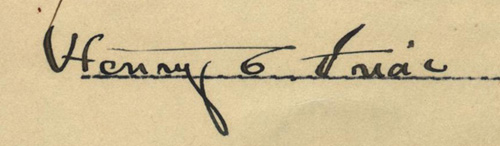
1919 signature of Henry Clay Frick
courtesy of Oliver Clemons
I catalog signatures from key national and international celebrities whose autographs are known on railroad stocks and bonds. Be aware that not all those people are considered "celebrities" outside of railroading.
Autographs that deserve separate listings
I do not catalog celebrities whose autographs have appeared for sale only only narrowly unless such individuals attracted extraordinary collector interest. Andrew Carnegie is one such person. It is difficult to quantify fame and celebrity, but it is clear that genuine celebrities must have impacted national or industrial history for their autographs to be collectible and therefore, attract elevated bids over time.
Railroad enthusiasts commonly desire autographs that ordinary autograph collectors know nothing about. Within that group are specialists who desire signatures from obscure people. When specialists bid against each other, they can cause temporary price spikes for autographs that most collectors would overlook. I ignore temporary price spikes and temporary interest in personalities that have been largely ignored. I list autographs that I think average collectors will want in the future. In recording prices over the span of several decades it is clear that some autographs have "staying power" while a significant number do not.
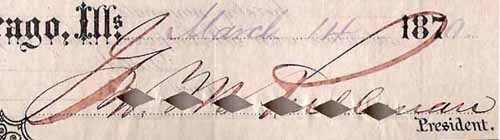
1870 cancelled signature of George Mortimer Pullman
courtesy of Volker Mueller
There are large numbers of now-obscure individuals who were important in specific regions and specific industries. Some may have been temporary celebrities and some may even have affected the course of regional history in important ways. Every history buff can identify numerous people who have been ignore by published histories. Yet, regardless of their "should-be" importance, price records clearly show collectors do not pay much for autographs from obscure and short-time celebrities.
There have been instances where books, motion pictures and television programs have altered the perception of previously obscure individuals among the general public. Values of certain autographs can increase rapidly in response to public attention. Given sufficient time, however, collector interest usually cycles back toward previous levels. I don't have a problem with dealers profiting from short-term popularity of obscure autographs. However, most collectors intend to be in the hobby for a long time. I hope they avoid being swept up in sudden bursts of new-found enthusiasm about a particular celebrity, only to find disappointment when trying to liquidate those autographs years later.
Try to be aware of the long-term popularity of specific autographs. Do not let any seller convince you to overpay for obscure autographs. Beware of artificial hype. Sellers can make obscure individuals sound terribly interesting and important when, in fact, many were neither.
Autographs that may not deserve separate listings and price estimates
I mentioned earlier that I now list autographs from twenty or thirty borderline "celebrities" that price history shows do not deserve much attention. Their names are somewhat famous, but their signatures have little if any effect on certificate prices.
It is important to accept that prices paid for all certificates are exceedingly variable. If I estimate a price for a particular, non-autographed variety at $100, I fully expect actual prices paid to oscillate between $50 and $200 for that variety within the span of a few years, regardless of the presence of autographs.
What if you don't know whether a signatory was a genuine celebrity?
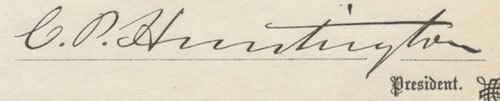
1878 signature of Collis Potter Huntington
courtesy of David Adams
When dealing with autographs on stocks and bonds, there are frequently questions whether the people who signed items were really celebrities at all. I believe information about true celebrities should be VERY EASY to find. Descriptions of genuine celebrities should appear in:
- major biographies
- major biographical dictionaries
- major encyclopedic sources
Online sources are acceptable sources for information, but the same rules apply. Scattered references to individuals on a limited number of web pages does not transform every dead person into a celebrity. References should be numerous and diverse.
Information about company presidents is especially difficult to find. That should indicate that very few company presidents were major celebrities. In fact, very few railroad presidents were notably famous beyond the service areas of their companies. Collectors of such specialized autographs may need to turn to library research. The good thing about collecting those kinds of autographs is that there is often very little competition and minimal threat of counterfeiting. However, "secretarial signatures" are major problems. (Secretarial signatures are those signed by clerks on behalf of others.) Secretaial signatures are often verifiable by comparison with other documents. Look VERY, VERY carefully at any signature followed by "...& Co." or "atty" (attorney.)
A simple test for celebrity
If it is hard to find information about people who signed certificates, then those people were not major personalities. Don't let anyone tell you they were. It should tell you something if it takes you more than a few minutes to discover important facts beyond birth and death dates.
Pricing certificates with celebrity signatures
In order to estimate prices for autographed certificates, celebrity autographs must meet two criteria:
- Signatories must be listed in numerous, easy-to-find biographical sources and they must be discoverable in many different sources within two or three minutes of searching on the web. Just because an "AI" can find information faster does not automatically confer importance. Force the "AI" to quote many sources.
- Autographs must appear on several railroad certificates. While exceptions are made for people of great fame, what good would it do to list a so-called autograph and try to estimate its price if only one or two certificates exist?
What about certificates issued TO celebrities, but not signed by them?
Some people collect famous names on certificates, regardless of whether celebrities signed them or not. There is some demand for those kinds of curiosities. I list a few "issued to" certificates when they meet the same requirements as autographs.

Many $1,000 and $10,000 Western Maryland Rail Road bonds were issued to, but not signed by
John Davison Rockefeller in 1917. Image courtesy of Mike Nicholson.
If ever in doubt about price estimation or inclusion of additional celebrities, please remember:
- Not everyone who signed certificates was a celebrity.
- Not all signatures have value to collectors.
- Not everyone with a famous last name was a celebrity.
- Extremely few company executives should be considered celebrities.
- Autographs have value only when many collectors agree.
- Autographs considered valuable at one point in time do not necessarily retain value.
- Extremely few military and political figures achieved sufficient fame for their signatures to be valuable over time.
- Autograph collecting is almost always about the money.
Authentication
Buy truly legitimate autographs. Not every signature is legible and not every signature was signed by the person in question. Collectors are advised to first decide whether prospective autographs look real to them. It is often difficult to find validated examples for comparison, so authentication by experienced and reputable third parties may be needed.
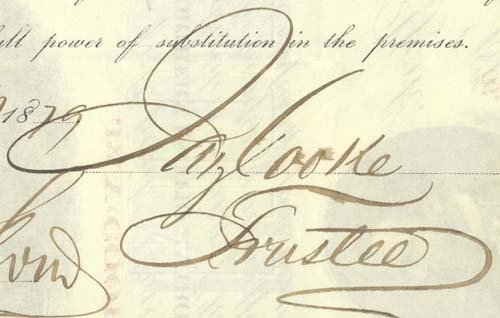
1879 signature of Jay Cooke courtesy of William Knadler
The more expensive the autograph, the greater the need for validation.
Third party experts should never have overt relationships with sellers of prospective purchases. It is usually impossible to acquire third party validation before purchase so collectors usually must pay for and take possession of autographed items before submission to autograph experts. Consequently, collectors must make absolutely certain they are dealing with reputable dealers who will accept returns and fully refund purchase costs. Postage is normally considered the responsibility of buyers.
Warnings for beginning collectors of autographed railroad certificates
NEVER collect autographs unless you know precisely why YOU must own them. Who cares whether sellers list specific names as so-called autographs? Mentioning names in a certificate description does NOT make autographs valuable. It certainly does not mean that signatures will retail value in the future. Why would you spend money on autographs if you don't already want them in your collection?
I recognize that specialists collect autographs from hundreds of individuals who I do not catalog. Non-cataloged autographs may have definite and significant local values. Please understand that autographs of locally-important individuals usually have limited value elsewhere.